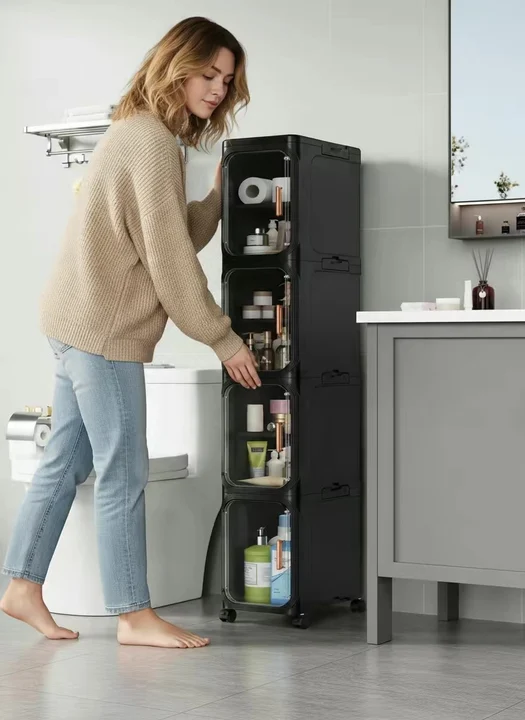
There is a specific satisfaction in folding a stack of sweaters into neat rows, sorted by color, edges lined up. For about ten minutes, your shelf looks like the display wall of a well-run clothing store.
Then one of two things happens. Either the shelf stays open and the rows gather dust, shed fibers, and slide into collapse the first time you pull a sweater from the middle. Or you do the responsible thing and box everything up — and the beautiful system you built stops existing. Out of sight is out of inventory. Six weeks later you are buying a fifth gray sweater because you could not remember if you owned one.
That is the trap: the two storage options everyone knows both destroy the thing you actually made. You did not just fold clothes. You built a visible inventory of what you own. Open shelves expose it to dust and chaos. Closed bins erase it.
There is a third option, and it looks like this: fold the rows, close the clear doors, keep the inventory.
What the V70 Actually Is: A Closet You Can See Into
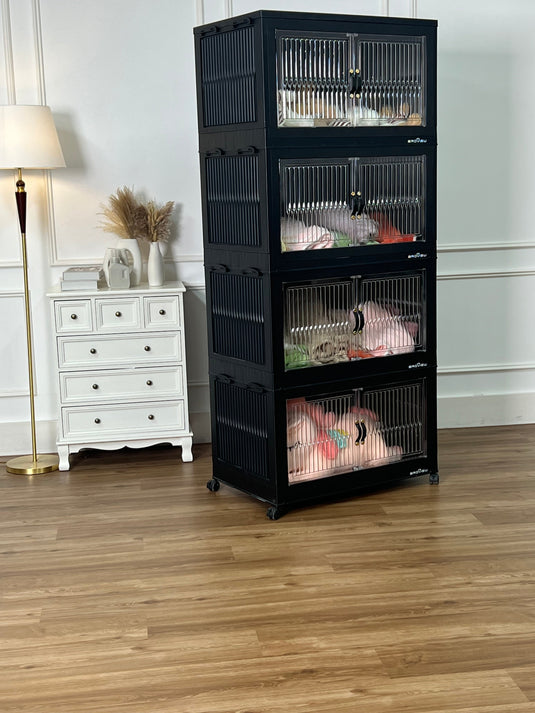
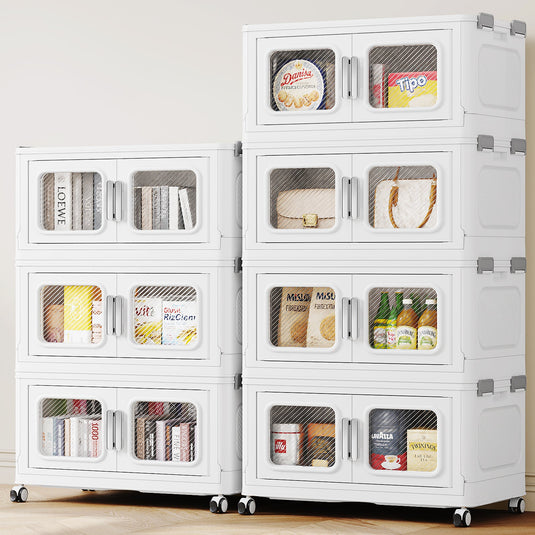
The V70 is a modular storage cabinet with fully clear PET front doors and a white frame. Each tier holds 160 quarts — real, mid-size storage, not a token drawer. The tiers stack into a tower, some sets can be split so each section works as an independent unit, and the base rolls on wheels so the whole thing moves when the room needs to change.
But the door is the product. Because it is clear, the folded rows you made stay visible after the doors close. Sweaters by color on one level. Jeans and heavier knits below. The category you built is still there, readable from across the room, without opening anything.
It is storage first and a display second — which is the correct order. The clear door is not asking you to perform for guests. It is making sure that what you organized stays organized in your head, not just on the shelf.
The Two Failed Alternatives, and Why They Fail
Open shelving keeps the inventory visible, which is why people love it in photos. In a real home it keeps everything visible to dust, sunlight, and whatever the cat drags onto it. It also has no failure tolerance: one rushed morning, one sweater stuffed back wrong, and the display becomes clutter with better lighting. You end up re-folding the shelf as a chore instead of using it as a system.
Opaque bins solve dust and chaos completely — by deleting the information. A bin labeled "sweaters" is a promise about the past. Six months in, you no longer trust it, so you open three bins to find one item, and the system decays into piles. The bin did not fail physically. It failed as an inventory.
A dresser drawer is the same problem stacked vertically. Drawers hide by design; anything folded into a drawer is stored for the version of you with a perfect memory.
The V70 takes the visibility of the open shelf and the containment of the bin and keeps both. Covered, so the rows stay clean. Clear, so the rows stay known.
160 Quarts Per Tier: What Fits in One Level
Volume claims mean nothing until they are translated into a real load, so here is one tier.
One level takes a full category of folded clothing — a dozen or more sweaters and knits in visible rows, with room to lift one out without collapsing the stack. It holds a set of off-season clothes, spare bedding and throws for the guest room, or the bags and accessories that currently live in three different closets.
The useful mental model is the same one from the folding method itself: one category per level. Knits on one tier. Bottoms on another. Bedding below. When each level is a category, the clear doors turn the whole tower into an index — you read the tower top to bottom the way you would scan a shelf, and you already know which door to open.
The Modular Part: Storage That Reconfigures
The photo at the top of this article is the part most storage cannot do. Each tier is its own box, so the stack is a decision, not a commitment.
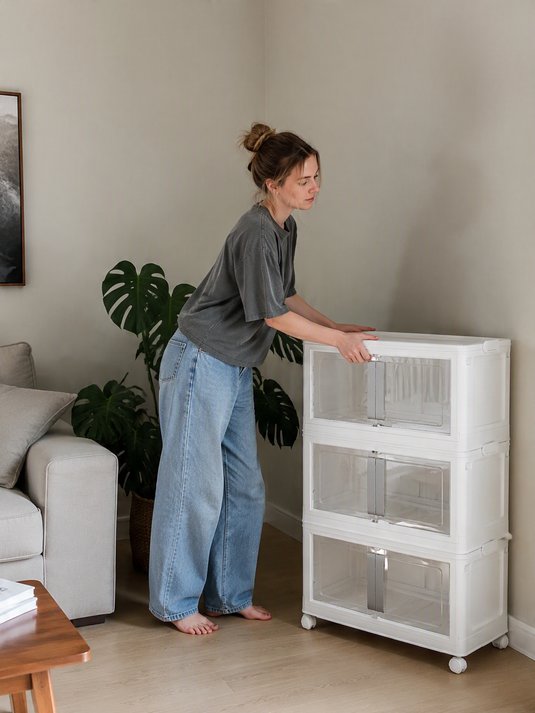
Tiers stack into one tower when you want a single clean unit against the wall. Depending on the set, sections can be separated and used on their own — one in the bedroom for knits, one in the playroom, one wherever the overflow moved this season. The wheels underneath mean the assembled unit rolls forward for cleaning or rolls across the room when the layout changes, instead of requiring an unloading session first.
That matters most when your storage needs are seasonal. Winter knits come out of the tower in April and bedding goes in; the container does not care what it is indexing. And on move day, the whole system breaks back down instead of being taped shut and carried like furniture.

Who This Is Actually For
The folded-rows people
If you already fold by method — rows, by color, file-folded — the V70 is the container your system has been missing. Your work stays visible instead of disappearing into a bin, and it stays clean instead of drifting into shelf collapse. This is the group the product was obviously designed around.
Parents running toy rotation
Toy rotation only works if you can remember what is packed away. Puzzles on one level, soft toys on another, craft supplies below — all visible through the doors without opening a single one. When the playroom layout changes, the wheels move the setup instead of you dismantling it.
Small-space and rental dwellers
A visible storage tower does the job of an open closet in a footprint that opens closets do not fit. It stacks up one section of wall instead of spreading baskets across the room, it needs no installation, and when the lease ends it folds down and moves with you.
The Honest Limits
The doors are clear PET panels, and the cabinet is not a display case for a museum. They are fully see-through, but this is normal household storage, not archival protection — it is not a sealed environment, and it is not built for patios or garages with real temperature swings. Keep it indoors, in dry rooms, holding dry things.
It is also not invisible. If the contents are messy, a clear door makes the mess more visible, not less — that is the deal. The system works when the levels stay categorical. Folded rows in, folded rows out.
How to Set It Up So It Stays Good
Three rules, five minutes.
One category per level. Not "clothes" — knits, or bottoms, or bedding. The index only works if each door has one answer.
Eye level earns the daily items. Whatever you reach for weekly goes in the middle tiers. Seasonal and less-used pieces go higher, bulky extras go lower. A tower you read top to bottom should be sorted by frequency, not by when you bought the boxes.
Refold the one stack, not the shelf. The failure mode of open shelving is that pulling one sweater wrecks the row. With file-folded rows in a deep tier, you can lift one item out and close the door before anything notices.
Frequently Asked Questions
Are the doors actually clear, or frosted?
Fully clear. The V70's front doors are transparent PET panels — you can read folded rows and identify items through the closed doors, which is the entire point of the design. They are clear PET panels — not tinted, not frosted, and not a textured surface.
What does 160 quarts per tier hold?
One level holds a full category of mid-size household items: a dozen or more folded sweaters in rows, a set of off-season clothes, spare bedding, bags and accessories, or a rotation of toys and puzzles. It is real closet-scale storage per level, not drawer-scale.
Can I split the stack and use tiers separately?
Depending on the set, yes — sections can be separated and used as independent units in different rooms. Check the set configuration on the listing before ordering if that is part of your plan.
Do the tiers need to be fixed to the wall?
No. The tower is free-standing and rolls on wheels, so it can be pulled forward for cleaning and moved when the room changes. Nothing gets mounted.
Will sunlight fade the clothes inside?
Any fabric left in direct sun can fade over time, clear door or not. Place the cabinet out of prolonged direct sunlight, as you would with an open shelf — the difference is that the doors keep dust and everyday grime off either way.
Is it suitable for a garage or basement?
In a dry, indoor basement corner, yes. It is not a sealed outdoor container, and it is not designed for damp spaces or real temperature swings. Treat it as room furniture, not equipment.
Does it fold down for moving?
Yes. The cabinet folds down when empty, which is what makes it workable for renters and anyone who moves — it packs flat instead of traveling as assembled furniture.
What should I not store in it?
Anything damp, anything that needs a sealed or climate-controlled environment, and anything you would not want on an open shelf — because a clear door shows contents, not just categories. Loose photos and documents belong in proper storage.
Keep the System You Already Built
The folding was never the hard part. The hard part is that everything after the folding — the box, the bin, the drawer — takes your visible inventory and locks it away, while open shelves tax it with dust and drift.
A clear-door tower ends that trade. Folded rows stay folded, visible, and clean, in 160-quart levels that stack, split, and roll. You get the boutique shelf on day one and, more importantly, on day ninety.
Sort your categories, measure your wall, and check the V70 tier configurations on the listing to match the setup to your room.