Same Cabinet, Three Sizes: How Quarts Per Tier Decide What Actually Fits
Here is a shopping mistake that costs people more than they realize. You see a foldable storage cabinet, you like it, and then you buy the biggest version. Not because you measured anything. Because bigger feels safer.
Three months later the thing is half empty. The tiers are so deep that things disappear into the back. A jar of old receipts is living in a space that could have held a folded comforter. And you are still stepping over the same pile of blankets in the hallway, because the cabinet was never sized for that pile in the first place.
Quarts per tier is the number that actually decides this. Not the total capacity printed on the listing, and not the height of the whole stack. It is the volume inside one level — the amount of stuff you can put in a single section without jamming the door or losing track of what is back there.
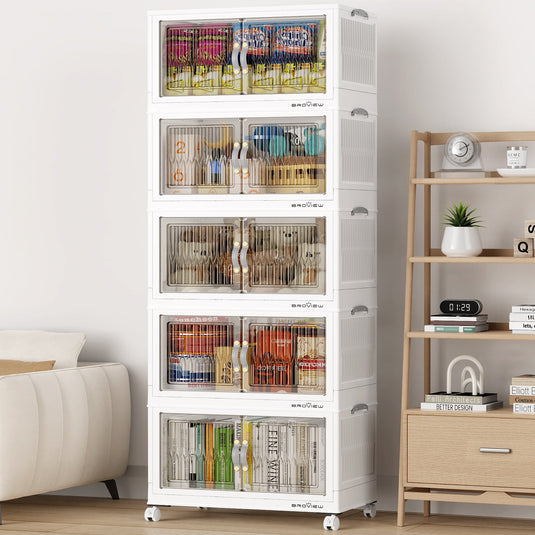
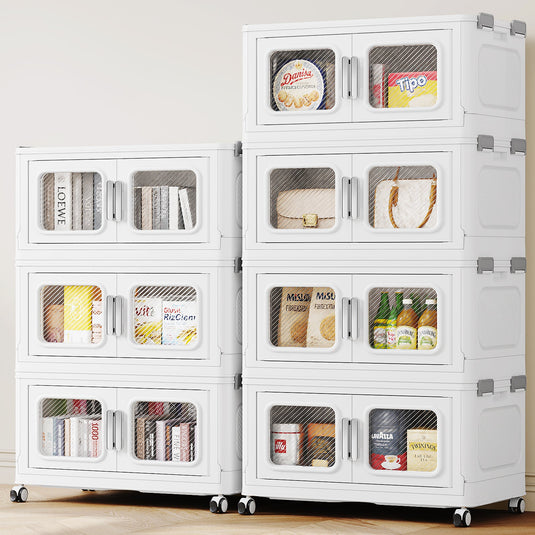
That is the whole idea behind the BROVIEW V80 foldable storage cabinet. It is not one product. It is the same cabinet platform built at different per-tier volumes, so you can match a section to the specific thing that has been taking over your floor.

Why the Cheap Folding Cabinet Fails First at the Door
Before sizes, there is a quality question to settle, because it decides whether any capacity number is worth anything.
Foldable storage is hard to build well. Most of it looks fine in photos while it is still flat in the box. Then you put the panels up and the sides flex. The doors do not line up at the seam, and you start planning a replacement before you have finished loading it.
On the V80, the frame locks in firmly, the base stays flat, and the magnetic doors close neatly. It goes together with no tools and folds back down the same way. That matters for one practical reason: a section only works as modular storage if it survives being moved. If the doors go crooked the first time you relocate it, you did not buy a system — you bought a plastic bin with extra steps.
So the honest comparison is not how many quarts. It is whether the cabinet still closes properly a year from now. Look at the frame and the door alignment first. Then look at the volume.
120 Quarts Per Tier: Everyday Storage and Rooms That Change
This size solves the category problem most homes have but nobody names.
Think about what is scattered around your house with no home: paper towels and extra paper goods, folded bath and kitchen towels, food containers, the kitchen items you do not reach for every day, backup toiletries, cleaning refills. None of it is heavy. All of it is bulky and awkward. It spreads across counters and closet floors because no single place fits a whole category at once.
At 120 quarts per tier, one level holds one real category. Instead of stacking everything into one mixed pile, you assign a section per category: one for paper goods, one for folded towels, one for the food containers and rarely-used kitchen items.
Most of the time those sections stay stacked and read as one cabinet. But a section can be separated and moved. If the laundry room needs storage, or the pantry overflows, you take one tier worth of capacity to that room instead of buying something new for it.
That is what makes it a modular system rather than a bigger box. It is also the right size for apartments, where a full multi-tier cabinet may be more storage than the floor plan can justify.
220 Quarts Per Tier: Bedding, Bulk, and the Things That Only Fit Alone
There is one category of household item that ignores every normal storage rule: a thick comforter.
Folded, a single heavy comforter can take up most of a 220-quart tier. That is not a design flaw — it is exactly why this size exists. You cannot split a comforter into three convenient pieces. It goes in whole, or it stays on the chair in the corner.
Around those oversized items, the other levels still do useful work: pillows, sheet sets, seasonal clothes, the fabric and paper goods that piled up from the last bulk run. Heavy items stay low, lighter items go higher. The point of a tier this large is that bulky bedding stops competing with everyday storage for the same shelf.
Two things matter more at this size than at 120. First, front access — a full level of bedding is heavy, and opening the tier you need without unloading the ones above is the difference between using it and avoiding it. Second, the wheels. When the cabinet is full, the wheels are how the floor behind it gets cleaned. A loaded cabinet that cannot be moved becomes a permanent wall.
If your problem is a stack of comforters, duvets, and guest-bed linens living on a spare chair, this is the size that addresses it. If your problem is a few towels, it is more than you need.
300 Quarts Per Tier: Garage, Basement, and Once-a-Year Bulk
This is the top of the range, and it is worth being precise about what it is for, because the biggest number on a listing attracts the most misunderstanding.
A tier this large is built for oversized items and bulk supplies that normally consume several smaller bins at once. Holiday decorations and lights. Camping gear. Oversized seasonal bedding. The bulk household supplies that arrive in multi-packs and then have nowhere to go.
The front doors open even when the setup is stacked, and the top lid opens for the loads too awkward to angle through a door. At this volume, most people reach for it in the garage, the basement, or a utility corner where a large footprint is not competing with living space.
Two honest limits apply. Capacity is not the same as protection — this is indoor dry storage, and storing damp gear or anything outdoors long-term is a different problem than this cabinet solves. And do not size up as a reflex. If what you actually need stored is daily toiletries and a few towels, a larger tier will just be a large empty space you paid for.
The Part That Is the Same at Every Size
Because the V80 is one platform built at different volumes, the way you use it does not change between sizes. Only the amount in each level does.
No tools, and it folds back down
The frame goes up without tools and breaks down the same way. This is what makes the cabinet practical for rentals and move years — when the lease ends, the cabinet comes with you and folds flat, instead of being donated to the building.
Front access, even when stacked
Each section opens from the front. The item you need at the bottom does not require lifting the tiers off the top first. Once you have lived with a system that opens from the front, going back to a stack of bins you have to unbuild is genuinely irritating.
Wheels and side buckles
The wheels let you pull the whole setup out to clean around it, or move one section to another room when the categories change. The side buckles hold the stack tight so the sections stay lined up as one cabinet rather than drifting apart.
Magnetic doors
The doors close with a magnet, not a latch. Small thing, but it is the reason you will actually close them — and the reason an open door does not become a broken door when someone walks past it.
Close the Gap That Is Actually Costing You Money
That is the real cost of an awkward storage gap: you buy paper towels in bulk to save money, and then lose the savings to a hallway you can barely walk through. The bulk only pays off if the supplies have somewhere to live.
So here is a test you can run this week, before you buy anything.
Walk through your home and write down what is living in the wrong place. Not "clutter" — actual categories. Paper goods. Towels. Bedding. Seasonal clothes. Decorations. Camping gear. Snacks. Refills. Most homes have five to eight of these, and they are almost never adjacent to each other.
Then find the one category that is causing the most physical annoyance — the pile you step around, the bag you move twice a week. Look at what a single tier of that category would need to hold, and how many levels of it you have. That number, not the biggest number on the listing, is what to shop for.
Then check the per-tier capacity on the exact SKU you are looking at. Tier counts and volumes vary across the range, and two listings that look identical in a photo can hold very different amounts per level.
Frequently Asked Questions
What does "quarts per tier" actually mean?
It is the internal volume of one single level, measured in quarts. It tells you how much one section holds on its own — the number that determines whether a comforter fits in a level or takes the whole thing. Total capacity across a whole stack is a different figure and is much less useful for planning.
Why does the same cabinet come in different per-tier volumes?
Because household storage problems come in very different sizes. A load of paper towels and a heavy king comforter cannot sensibly share one tier size. Building the same platform at multiple volumes lets you match each section to what is actually in your home instead of forcing everything into one compromise.
Is a bigger tier always the better choice?
No. A very large tier holding a few small items is wasted space and wasted money, and it makes it easier for things to get lost at the back. Size up when you genuinely have oversized items — comforters, bulk supplies, seasonal gear. Stay smaller when your categories are everyday items.
Do I need tools to assemble it, and can I reach a lower tier without unloading the ones above?
No tools — the frame goes up by hand and folds back down the same way. And yes, each section opens from the front, so the tier you need is accessible in place even when the sections are stacked and buckled together.
Can I split the stack and use sections in different rooms?
That is the point of the design. Sections can be separated and used individually, so one setup can serve a pantry, a laundry room, and a bedroom at the same time — then be recombined later when the categories change.
Where should I not use it?
Indoors, in dry conditions. This is not an outdoor storage box and it is not a sealed container, so gear should be clean and fully dry before it goes in. It is storage, and should be used as storage.
Match the Volume to the Problem
The most useful thing you can do for your home this month is not buy the most storage. It is figure out which single category is causing the most friction, and buy exactly enough cabinet for that one problem.
Then the paper towels have a home. The comforters have a home. The decorations come out in December and go back in January to the same section. And the dining chair is a chair again.
That is what a storage system is supposed to do — give things a fixed address, and give your space back.