One Tier, One Category: How 60 Quarts Per Level Finally Ends the "Where Does This Go?" Problem
Walk through your kitchen right now and count the places where everyday stuff is hiding. Paper towel rolls on top of the fridge. Backup shampoo under the bathroom sink, behind a bag of cotton balls you haven't opened since 2023. The Costco run from two weeks ago colonizing one end of the dining table. A basket of snacks on the counter. A drawer of "miscellaneous" that makes a small rattling sound when you open it.
None of it is junk. That's the problem. It's all stuff you actually use — just stuff that never got assigned a real address. So it keeps migrating: fridge top, pantry floor, guest room closet, garage shelf, back to the counter. And every single day, you spend a few minutes hunting for something you know you own.
This is the part of home organization almost nobody talks about. It's not about having less stuff. It's about every category of stuff having one fixed place. That's what the BROVIEW V8 60QT foldable storage box was built around — and why "60 quarts per tier" matters more than the total capacity number on the box.

Why "Total Capacity" Is the Wrong Number to Shop By
Most storage bins are sold on one big number. 120 quarts. 200 quarts. The implication is that bigger means more organized.
In real life, a giant bin doesn't organize anything. It just relocates your chaos into a single container, where it all mixes together again. Drop paper towels, sunscreen, batteries, and a spare phone charger into one 200-quart bin and you've created a smaller version of the exact problem you were trying to solve. You still have to dig. You still don't know what's in there. And you will absolutely buy a second bottle of sunscreen because you can't find the first one.
Per-tier capacity is a different way of measuring. Each tier of the V8 holds 60 quarts — enough for one complete category of everyday items, and only one. Paper goods get their own tier. Household refills get their own tier. Snacks get their own tier. Beauty and toiletries get their own tier. When every level is single-purpose, "where does this go?" stops being a question, because the answer is written into the structure itself.
And 60 quarts is a genuinely useful size. It's big enough to absorb a full Costco run of paper towels and napkins, but small enough that you can still see the back of the tier without emptying it onto the floor. That's the sweet spot most oversized bins miss entirely.
The Everyday Categories That Never Had a Home
Let's name the actual offenders, because vague advice doesn't organize anything.
Paper goods. Toilet paper, paper towels, napkins, tissues, paper plates for the nights nobody wants to do dishes. These come home in bulk and then live on the floor of a closet or on top of a cabinet where you need a step stool to reach them. A 60-quart tier swallows an entire bulk pack and keeps it standing upright instead of slowly collapsing into a pile.
Household refills. Dish soap, hand soap, laundry detergent, sponges, trash bags, refill packs of cleaning wipes. This is the category that multiplies silently. You buy the two-pack because it's cheaper, use one, and the other goes wherever there's room. Then next month you buy it again because you forgot you had it.
Snacks. If you have kids, or if you have a Costco membership, you have a snack overflow problem. Boxes of granola bars, crackers, fruit pouches, popcorn, drink mixes. Right now they're probably in two or three different cabinets plus one basket that gets moved around.
Beauty and toiletries. Backup shampoo, body wash, razors, cotton pads, hairdryer, the curling iron you use twice a year. Under-sink cabinets are where toiletries go to be forgotten, usually behind a pipe.
Folded everyday clothes. Not seasonal wardrobes — the daily stuff. Gym clothes, kids' uniforms, pajamas, towels if your linen closet is already full. These are the items that end up on the chair in the bedroom, which hasn't been sat in since roughly last winter.
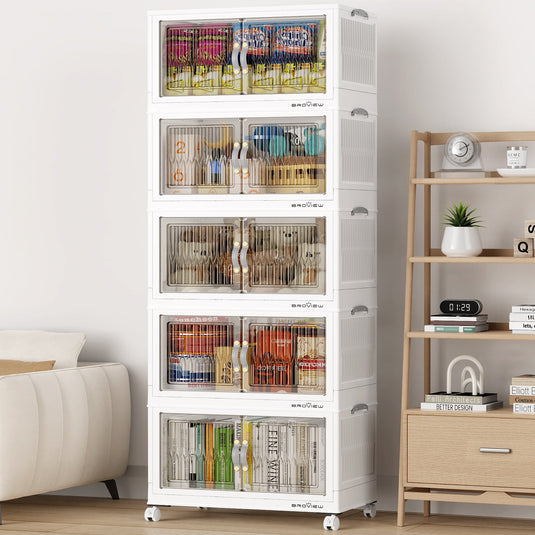
A single tier of the V8 absorbs any one of these categories completely. Stack four tiers and you've given four categories a permanent home in the footprint of a small chair.
[Insert Image 2 here: overhead or three-quarter angle looking down into an open tier of the V8, showing one single category neatly contained — upright paper towel rolls and stacked napkins, nothing else mixed in — clean bright lighting]
Why Front-Opening Changes the Whole Equation
Here's where traditional stacked bins fall apart — literally, in terms of usability. You stack them because floor space is expensive. Then the thing you need is in the bottom bin. So you unstack the top two, set them on the kitchen counter or the floor, dig out what you wanted, and then stand there looking at two bins that need to go back up. Many of those bins stay on the counter for three days, because putting them back feels like a project.
The V8 solves this at the design level. Every tier opens from the front, even while it's stacked. You walk up, open the door on the level you want, grab the thing, close it. Nothing gets lifted. Nothing gets moved. The whole tower can stay assembled for years and you never have to take it apart to reach the bottom.
That one detail is what turns a storage unit into an actual system you'll keep using past the first enthusiastic weekend.
The Details That Keep It From Looking Like a Plastic Bin
A storage box that solves a logistics problem but looks like a warehouse container isn't going to survive in a living space. It ends up banished to the garage, and then the paper towels go right back on top of the fridge.
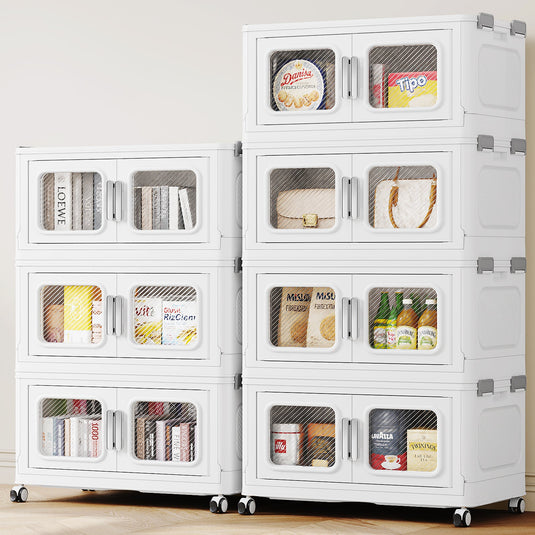
Three things keep the V8 acceptable in a real room. The white frame reads clean and neutral instead of industrial. The smoky ribbed doors hide just enough of what's inside — you get a sense of the category and the shelf stays visually calm, but you're not staring at a display case of detergent bottles and snack wrappers. And because each tier holds one category, the interior stays orderly enough that the semi-transparent door actually looks intentional rather than like evidence.
It also has magnetic door closures, which means the doors stay shut on their own and close with a soft click instead of a plastic clack. Small thing. You notice it every single time you use it, and you definitely notice it at 6 AM when you're grabbing a snack before anyone else is awake.
One more practical detail: the bottom tier rolls out, so you can pull the unit away from the wall to sweep or vacuum behind it instead of leaving a permanent dust stripe back there. And when you need to reorganize, you can bring the tier to whatever you're sorting, rather than carrying armfuls of stuff across the house.

Who Ends Up Buying This
Renters in small apartments. If you're paying rent by the square foot in New York, San Francisco, Chicago, or Boston, floor space is your most expensive asset. A vertical tower that opens from the front uses the one dimension apartments always have spare — height — and never makes you reshuffle furniture to reach the bottom level.
Households with a bulk-store habit. If your shopping list starts at Costco, Sam's Club, or BJ's, you buy in packs whether or not you have somewhere to put them. The V8 gives bulk purchases a fixed address instead of letting them spread across the pantry, the garage, and the top of the fridge.
Families with kids. Snacks, paper goods, craft supplies, backup school supplies, sports gear — families generate categories faster than they generate storage. Giving each category its own tier means a kid can actually be told "your snacks are on level two" and succeed at finding them. That's worth more than it sounds like at 4 PM on a school day.
People in a bedroom with one under-used corner. The chair covered in clean laundry. The corner behind the door. The four feet of wall next to the dresser that's holding a lamp and nothing else. A stacked tier system turns that dead vertical space into closets you don't have.
Frequent movers and college students. This is where the foldability earns its place. When it's time to pack, each tier collapses down into a flat panel in a few seconds and no tools are involved — no screws, no brackets, no instruction booklet you'll lose. Flat panels go in the trunk, under a bed, or against the back wall of a closet. Then they pop back up on the other end.
Cardboard, Fabric, Rigid Plastic, and the V8
Cardboard boxes are free and immediately available, which is their only real advantage. They soak up humidity from the air, so anything stored in a garage or basement picks up that damp cardboard smell within a season. Bugs and silverfish find their way in. And structurally, they fail fast — stack two and the bottom one starts bowing within weeks.
Fabric bins look soft and forgiving and photograph beautifully. Then you load one with actual weight — a stack of paper goods, bottles of detergent — and the sides stretch and sag until the whole thing leans. They offer no moisture barrier at all, they can't hold their shape under stacking, and they don't have a door, so the only way to reach anything is to dig in from the top.
Rigid plastic bins solve the moisture and stacking problems, and they protect what's inside well. The issue is that they only work in one mode: full and in the way. A rigid bin can't be reduced. It takes the same amount of floor space whether it's holding a full season of paper goods or sitting empty because you've stopped doing bulk runs. In an apartment, that's a real cost — you're paying for those stubborn square feet every month.
The V8 keeps the parts of rigid plastic that matter — a PP frame that doesn't absorb moisture or sag under stacking, solid protection for what's inside, semi-transparent ribbed doors so you can see the category — and adds the thing no rigid bin has ever managed. It opens from the front while stacked, and it folds flat to a few inches when you don't need it. You stop paying floor-space rent on empty containers.
How to Set It Up So It Actually Stays Organized
Measure first. This is the step everyone skips and then regrets. Before you decide how many tiers you want, measure the wall space you're considering — width, and the available height including any ceiling slope, outlet, or light switch you'd be blocking. Measure the clearance in front too, so you can open a door without hitting a doorframe or furniture.
Then assign one category per tier, and be strict about it. A good starting order for a kitchen or hallway setup: paper goods on the bottom tier, because that's usually the heaviest and you'll reach for it in bulk. Household refills next. Snacks above that, since snacks get accessed most often and the middle is the easiest reach. Beauty and toiletries on top, because those are the lightest and least frequently restocked. Folded everyday clothes or towels can take a tier too if your linen closet has given up.
Keep a permanent marker or a small label on each door if you want to be strict about it, though the ribbed semi-transparent panels usually make labels unnecessary — you'll learn which level is which within a week.
And when your categories change — because they will — you don't need a new storage system. You reassign a tier. Stack it higher, split it into two smaller stacks in two rooms, or fold the extra panels flat and slide them under the bed until the next Costco phase.
Start With the Categories, Not the Container
The reason storage systems fail isn't that people buy the wrong box. It's that they buy a box first and then try to figure out what goes in it, which means everything goes in it.
Flip the order. List the four everyday categories currently living in the wrong places in your home — paper goods, refills, snacks, beauty products, whichever ones are actually yours. Then get a tier for each. The BROVIEW V8 60QT foldable storage box is designed so that each 60-quart level is one category, opens from the front even when stacked, and folds flat when your needs change.
Measure your space, pick your tier count, and give your everyday extras a real home instead of a temporary one.
[Insert Image 4 here: before/after split frame — left side shows the everyday chaos version (paper goods on top of the fridge, snack boxes on the counter, bottles under the sink); right side shows the same items sorted into separate categories across the stacked V8 tiers, doors closed and tidy]
Q: What does "60 quarts per tier" actually mean in practical terms?
Each individual level of the V8 holds 60 quarts of volume — enough for one full everyday category, like a bulk pack of paper goods, a set of household refills, a family's snack supply, or a collection of beauty and toiletry backups. It's the per-level capacity, not the total for the whole stacked unit.
Q: Can I open a tier while the unit is fully stacked?
Yes. Every tier opens from the front, so you never have to lift a tier off the stack to reach the one underneath. That's the main reason a stacked V8 stays usable long-term instead of ending up half-disassembled on your counter.
Q: Will I be able to tell which tier holds what?
The smoky ribbed doors are semi-transparent, so you get a sense of what's inside each level without it being fully on display. The ribbed texture also softens the look of whatever's in there, which is the main reason this doesn't read like a clear plastic bin full of supplies.
Q: How many tiers should I buy?
Count your categories first, then measure. One tier covers one category. If you have four categories and the height to stack four, a four-tier setup is the straightforward answer — but measure your available height and front clearance before committing. Choosing the number of tiers you'll actually use matters more than buying the tallest option.
Q: Can it be moved or reconfigured after it's set up?
Yes. The bottom tier rolls out, so you can pull the unit away from the wall to clean behind it or to sort through a category. Stacked tiers can also be split into smaller units in different rooms when your needs change.
Q: What happens to it when I don't need it anymore?
It folds flat. Each tier collapses into a flat panel in a few seconds with no tools required — no screws, brackets, or assembly hardware. The panels slide under a bed, behind a couch, or against the back of a closet, and reassemble just as quickly when you need them again.