The Linen Closet Problem Is Really a Where Problem
Notice that none of these items are hard to store individually. A towel fits almost anywhere. A shampoo bottle fits in a drawer. The problem is that "anywhere" is not an address — it is a decision you have to make every single week, and when storage has no fixed home, the same categories end up scattered across four rooms.
That is why the missing linen closet costs more than it looks like it should: every category ends up in the wrong room, and every guest-towel hunt turns into a small search operation.
A dedicated tower fixes this by giving each category a fixed address in one place — and by making them visible through the doors, so "where are the guest towels" becomes a glance instead of a search.
Why the Capacity Number That Matters Is Per Tier
The V40 holds roughly 200 quarts per tier — about 50 gallons on a single level. That is the number to shop by, not the total across a stack, because a tier is what has to hold the actual object. Bath towels for two bathrooms plus guest spares: a tier-sized problem. A bulk run of shampoo and soap: another. The guest-bed quilts: another.
It also protects you from the opposite mistake: one enormous open bin where every category blends into a single pile. At this size, one tier holds one category — which is what makes a tower of them behave like a closet instead of a landfill.
One Tier, One Category: A Setup That Actually Gets Used
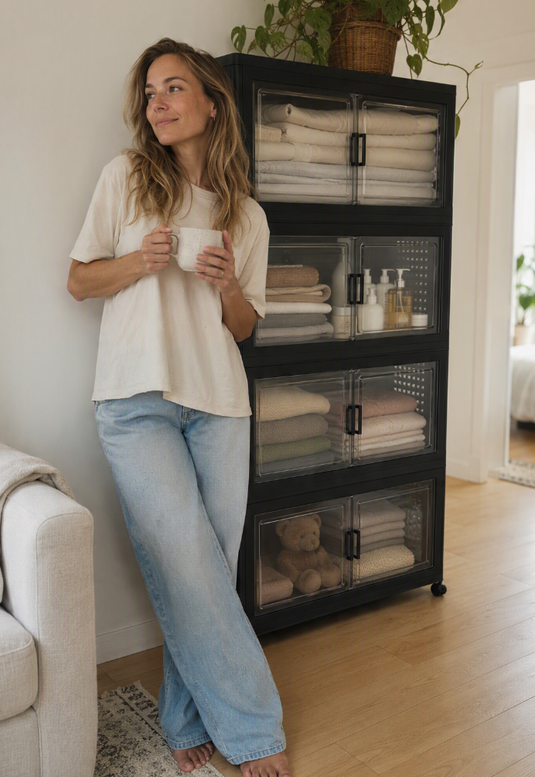
The tower in the photo works because each level got a single, boring, specific job:
Tier one — towels. Bath and hand towels folded in rows you can read at a glance. It is the level guests see first, and the one that makes the whole thing look deliberate rather than stored.
Tier two — the refill shelf. The bulk bottles: shampoo, body wash, lotion, the Costco-sized stuff that used to live on the bathtub edge. Behind a clear door, you always know how many backups are left — which ends both the out-of-soap emergency and the accidental double-purchase.
Tier three — spare bedding. The quilts and blankets that belong to the guest bed but only visit it twice a year. Folded flat, they fill a tier neatly, and they stop renting out the armchair.
Tier four — the kid zone. The bottom tier sits exactly at a five-year-old's reach, which is why the teddy bear and the stuffed animals live there. If you have ever stepped on a plush at midnight, you understand the value of one corralled, door-closable home. It doubles as a rotation shelf, too: half the toys in, half out, thirty-second swap.
None of this requires labels or a system you will abandon in two weeks. The doors are clear, so the inventory is the label.
Clear Doors Change the Math on Bulk Buying
Bulk shopping is only a bargain if the supplies have somewhere to live. The failure mode is familiar: the twelve-pack does not fit anywhere, so half lives in the trunk and half lives on the laundry room floor until it becomes part of the architecture.
Clear doors attack that failure directly: you can see the stock level of the refill shelf from across the room, so you restock when you actually need it. And because each tier is a closed unit, the bulk haul stops looking like a pile of commerce in the middle of your home — from the outside, it reads as furniture.
The Details That Make a Plastic Cabinet Behave Like Furniture
This is the part where cheap storage towers fall apart, so it is worth being specific about what to check on any unit you consider, including this one.
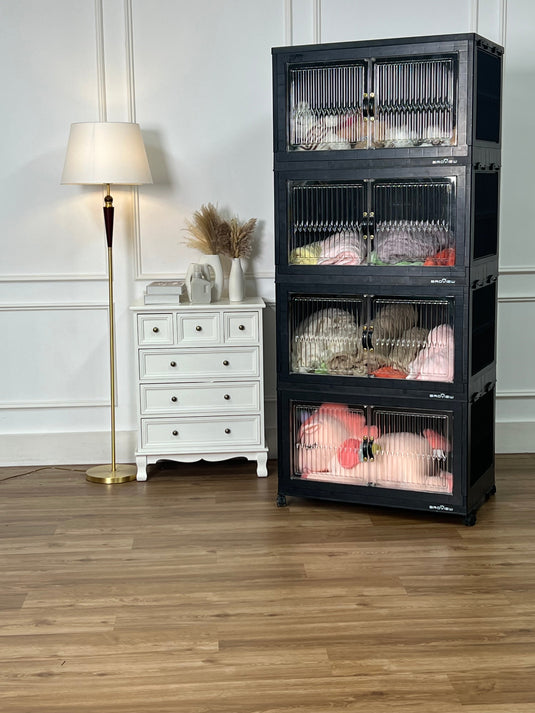
Front access, even stacked. Every tier opens from the front with a pair of magnetic doors, so the bottom-tier blankets never require unstacking three levels of towels to reach.
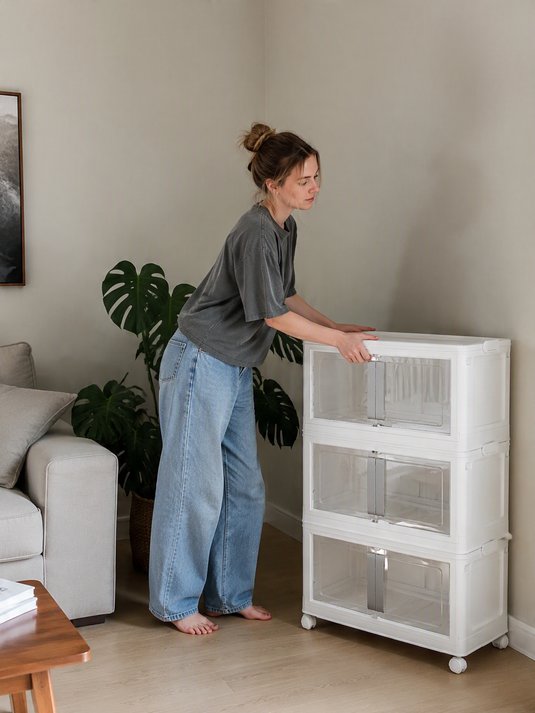
Wheels and side handles. The whole unit rolls, so cleaning behind it is a two-minute job instead of a move-the-furniture negotiation. When the blanket tier needs a seasonal swap, roll it out, open one door, done.
A frame that reads as furniture. The matte black frame with clear panels looks like a piece you chose, not a bin you are hiding. The top surface works, too — the plant basket in the photo is doing more work than any lid ever has.
Folds down when you move. It sets up without tools and folds back flat the same way. When the lease ends, the linen closet comes with you.
The divider option. Some V40 configurations include an adjustable, removable divider that splits one tier into two zones — refills on one side, towels on the other, or his side and hers. It ships with specific configurations rather than all of them, so check the exact listing.
Who This Setup Actually Fits
Homes without a linen closet. If your towels live in the bathroom and your blankets live on furniture, you do not have a tidiness problem — you have a missing room, and a tiered tower is the cheapest way to build one.
Bulk shoppers. The refill shelf alone justifies the footprint if you buy toiletries in bulk. Watching the stock through a clear door turns a twelve-pack into an inventory system.
Families with small kids. A bottom tier at kid height means cleanup is something a five-year-old can actually complete. A closet a child can close is a closet that stays closed.
Frequent movers and renters. No tools, folds flat, rolls on wheels. It travels with you instead of being abandoned at every move.
How It Compares to the Alternatives
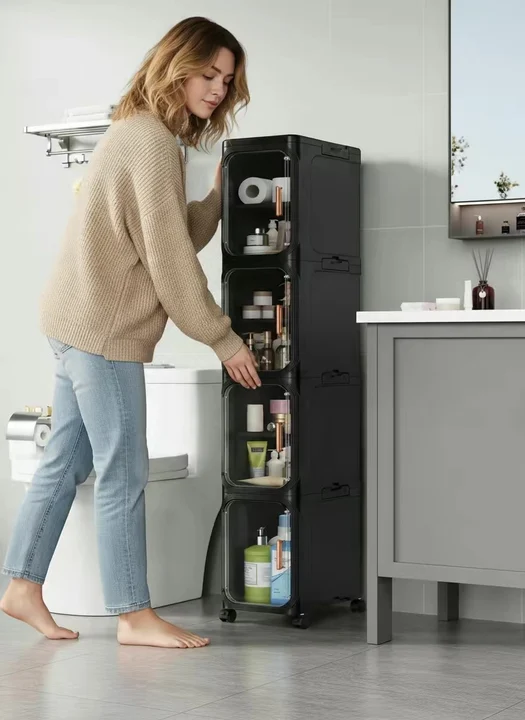
The bathroom vanity, where these towels usually end up, fails for a simple reason: it is humid, cramped, and already needed for the sink. Towels stored there stay slightly damp, and the bulk bottles were never going to fit.
An open shelf unit solves visibility but creates the dust problem — and open shelving in a living area reads as storage, not furniture. Everything on it is public.
Traditional tall bins hide the clutter but fail at access: opaque, top-heavy, impossible to inventory. You are back to opening three boxes to find the guest towels.
The tiered clear-door tower is the only option that gets all three right: closed like a cabinet, visible like a shelf, accessible at every level like a real closet.
The Honest Limits
This is indoor storage for dry rooms. It is not a sealed container, it is not built for patios or garages with real temperature swings, and anything that goes in should be clean and dry — towels included, which is one more reason the bathroom itself is the wrong home for them. It is also not a toy chest with a soft lid; the doors are rigid panels, so the bottom tier works for plush toys and folded dress-up clothes rather than a nightly toy-dump ritual.
And confirm two things on the exact listing before you buy: the per-tier capacity of that specific configuration, and whether the divider is included in it. Both vary by SKU, and the tower is only a bargain if the configuration matches the job.
Set It Up Like the Photo
If you want the version that keeps working after month three, steal the assignment logic:
List your missing-linen-closet categories in order of weekly annoyance — towels, refills, blankets, toys, whatever your version is. Give the most-visited category the eye-level tier, the least-visited the bottom, and anything a child should reach the lowest shelf. Then roll the finished tower where it is useful, not where it is hidden — a linen closet you can see is one you restock on time.
Then stop making the weekly "where does this go" decision. The tower already made it.
Frequently Asked Questions
How much does one tier actually hold?
Each tier holds roughly 200 quarts — about 50 gallons. To picture it: a full set of folded bath towels, a bulk run of toiletry refills, or a couple of spare quilts each fit comfortably on one level.
Can you really see what is inside the doors?
Yes. The front panels are clear, so you can read the contents — folded towel rows, refill bottles remaining — from across the room without opening anything.
Do I have to unstack it to reach the bottom tier?
No. Every tier has its own pair of front doors, so the bottom-tier blankets and the top-tier towels are equally reachable while fully stacked.
Does it include a divider?
Specific V40 configurations include an adjustable, removable divider that splits one tier into two zones — useful when one category does not quite fill a tier. Dividers ship with particular SKUs rather than all of them, so check the listing for the configuration you are buying.
Can it go in a bathroom, given the humidity?
It can stand in a dry hallway or bedroom corner near the bathroom — the better arrangement anyway, since the goal is that towels and refills stop living inside the humid bathroom. Keep the unit in a dry room and store only clean, dry items.
Will it work for toys?
For stuffed animals, dress-up clothes, and boxed games, yes — especially on the bottom tier at a small child's reach. For a nightly dump-everything-in routine, a lidded chest is the better tool; this is a closet, not a hamper.
Is it hard to assemble or move?
It sets up without tools, folds back down flat, and rolls on wheels with side handles. Moving it to a new room — or a new apartment — is a one-person job.
What should I check before buying?
Two things on the exact listing: the per-tier capacity of that configuration, and whether the divider is included. Everything else about the setup — front doors, wheels, fold-flat storage — carries across the range.