Nobody plans for the garage to become a warehouse. You buy in bulk to save money, you keep the holiday decorations because they come back every year, and the camping gear has to live somewhere. Eighteen months later the car is in the driveway and there is a narrow path from the door to the water heater.
The blame usually lands on "too much stuff." It is almost never that. It is that the storage in a garage is one long wall of closed boxes, and the box you need is very rarely the box on top.
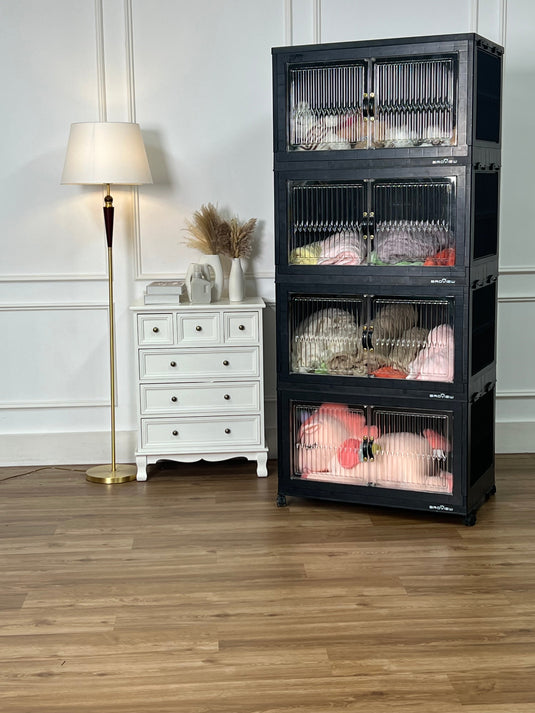
This is the problem the BROVIEW V80 foldable storage cabinet is built for. It is a modular platform, not one fixed size, and the way it is measured is different from the way totes are measured. Once you get the two numbers right, the wall stops being a wall and goes back to being storage.
Why a Stack of Totes Stops Working
Totes are the default for a reason. They are inexpensive, they stack, and they survive a concrete floor. The failure is not the material. It is the access.
A stack of top-load bins is a single door, and that door is the entire stack. To reach the one from last winter you lift four bins onto the floor, open the third, dig, find it under something else, then rebuild the wall. Nobody does that twice. So the bin you cannot reach becomes the bin you quietly buy a second version of.
There are two quieter costs as well. Cardboard soaks up whatever the concrete gives off and loses its corners when it is loaded, and a tote lid carrying the weight of the bins above it eventually stops sitting flat. Neither one fails dramatically. They just make you trust the stack a little less every season.
The Sizes, and What One Tier Actually Holds
The V80 comes in different per-tier volumes, and that is the number to plan with — the capacity of a single level, not the height of the whole unit. A tier is the unit you match to a real category of things.
120 quarts per tier: everyday categories
This is the size for the things that have no home but are not heavy: bulk paper goods, folded towels, food containers, backup toiletries, cleaning refills, the kitchen items you do not reach for every day. None of it is difficult to store. All of it is bulky and awkward, which is why it spreads across a workbench and the floor in front of the freezer.
At this volume, one tier holds one real category. You assign a section per category instead of mixing everything into one pile, and the section can be separated and moved to the laundry room or the pantry when the categories change.
220 quarts per tier: bulky bedding and overflow
A thick comforter can take most of one tier at this size, and that is exactly why it exists. Bedding cannot be split into convenient portions. It goes in whole or it stays on the guest bed all year.
Around the oversized items, the other levels still do useful work: pillows, sheet sets, seasonal clothes, guest linens. Heavier items low, lighter items high. The point of a tier this large is that bulky bedding stops competing with everything else for the same shelf.
300 quarts per tier: oversized and once-a-year gear
This is the top of the range, and it is the size that usually ends up in the garage, the basement, or a utility corner where a large footprint is not competing with living space. Holiday decorations and lights. Camping gear. Oversized seasonal bedding. The multi-packs of household supplies that arrive with nowhere to go.
Be deliberate here rather than defaulting upward. If what you actually need stored is a few towels and some paper goods, a tier this large is a lot of empty volume you paid for.

Front Access Is What Makes a Garage Wall Work
Every tier opens from the front. The item at the bottom of the stack does not require lifting the sections above it, which sounds like a small detail until you have lived with a system that opens the other way.
The doors close on magnets rather than a latch, so closing them is one motion and an open door does not become a broken door when someone walks past it with an armful of groceries. On the larger loads, the top lid opens for the items that are too awkward to angle through a door.
The practical result is that a full cabinet stays usable. Nothing in the back of a tier becomes permanently out of reach, which is what happens to the back of a deep tote within about two months.
Wheels and Side Buckles
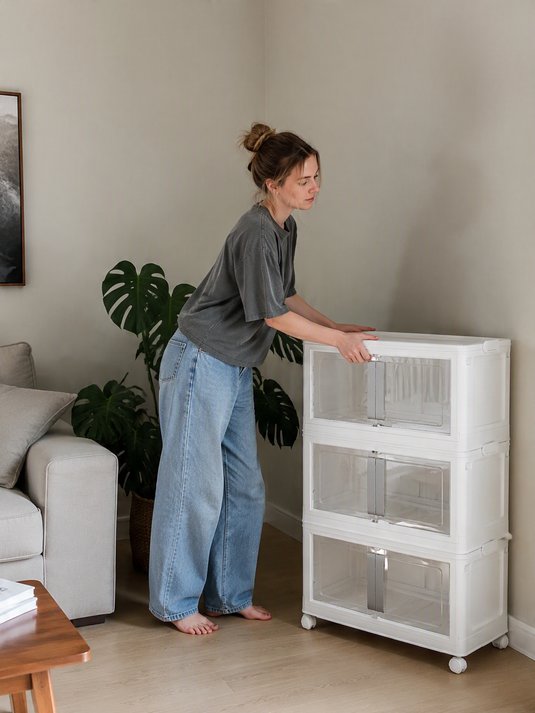
When the setup is loaded, the wheels are how the floor behind it gets cleaned, and how one section gets moved to the laundry room or the mudroom without unpacking it. A loaded cabinet that cannot be moved stops being furniture and becomes a wall.
The side buckles hold the stack together as one unit, so the sections stay lined up as a cabinet instead of drifting apart at the seams over time. When you do want to split the setup, they release in seconds.
The Once-a-Year Swap
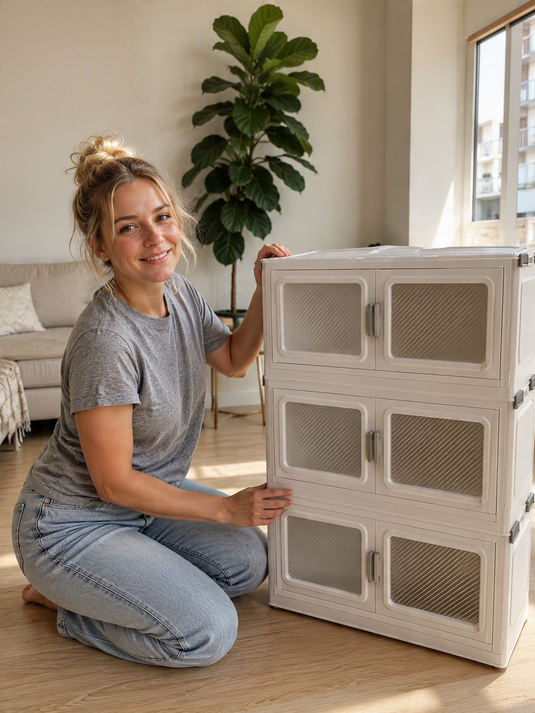
Most of what lives in a garage is seasonal, which means it moves twice a year: out in spring, back in late fall. That swap is where the tier system pays off, because you can take one section out, empty it, reload it for the new season, and re-buckle it without rebuilding anything around it.
April usually means winter gear out, camping equipment, sports gear, and lawn supplies in. December is the reverse, with the decorations coming back to the same section they came from last year. Because each level separates, a section can also spend the off-season in a different room entirely, then come back when the season turns.
And when a section is genuinely empty after the swap, it folds flat in seconds. That is the difference between storage that costs you floor space all year and storage that only costs you floor space when it is holding something.
[Insert Image 3 here: a BROVIEW V80 mid-swap — one section standing open on the garage floor half-loaded with holiday decoration boxes and a folded set of camping gear, the remaining stacked sections still buckled behind it, empty floor visible where the removed section used to sit, daylight from the side, no people]
If You Rent, or Move Every Couple of Years
Foldable storage is not only a garage idea. The frame goes up without tools and breaks down the same way, which changes the math on leases and move years. When the lease ends, the cabinet folds flat and comes with you instead of being donated to the building.
For a smaller floor plan, the sections do not have to stay together. One can live in the entry closet for coats and bags while another handles bedding in the bedroom, and both can be recombined later if the next place has a garage. You are buying a system, not a single unit that has to fit every home you will ever live in.
How It Compares to What You Already Have
Cardboard boxes are the cheapest option and the least durable — they lose their structure when damp or overloaded, they cannot be cleaned, and they get recycled after one move. Basic plastic totes are sturdier and they stack, but they load from the top, their lids carry the weight of the stack, and a deep tote hides its own contents. Fabric bins fold flat and are convenient in a closet, but the soft sides are the wrong answer for a concrete floor, damp air, and heavy gear. A foldable cabinet sits in a different place on that list: a rigid frame that closes properly, front access on every level, wheels and buckles so the stack behaves like one cabinet, and a flat fold when the season is over.
Setting It Up in Four Steps
Measure the wall, not the stack. Width and depth, plus room for the doors to swing and for you to stand in front of it. A deep cabinet against a shallow wall is the most common misfit.
List categories, not "clutter." Paper goods. Towels. Bedding. Seasonal clothes. Decorations. Camping gear. Lawn supplies. Snacks. Refills. Most homes have five to eight, and they are almost never adjacent to each other.
Match a per-tier volume to each category. Everyday items stay smaller. Oversized items get the large tiers. Do not size the whole cabinet for your worst category if only one category needs it.
Decide stacked or separated before you load it. All tiers in one place, or one section in the pantry and two in the garage. Deciding first is what keeps you from rebuilding it a week later.
[CTA: Shop the BROVIEW V80 foldable storage cabinet — check the per-tier capacity, the tier count, and the pack quantity on the exact SKU you are buying]
Frequently Asked Questions
What is the difference between the 120, 220, and 300 quart tiers?
They are different per-tier volumes on the same cabinet platform, so the size of one level changes, not the way it works. The 120-quart tier suits everyday categories like paper goods, towels, and containers. The 220-quart tier is built for bulky bedding. The 300-quart tier is for oversized and once-a-year items such as decorations, camping gear, and bulk supplies.
Can I open a lower tier without unloading the ones above it?
Yes. Every section opens from the front, so the tier you need stays accessible in place, even with the sections stacked and buckled together. That is the main reason this format holds up in a garage, where a top-load stack usually becomes unreachable near the bottom.
Do I need tools to assemble it, and does it come apart again?
No tools. The frame goes up by hand and folds back down the same way. That is what makes it practical for rentals and move years, and it is why an empty section can be folded flat instead of occupying floor space off-season.
Can I split the stack and use the sections in different rooms?
That is part of the design. Sections separate and work on their own, so one setup can serve a pantry, a laundry room, and a bedroom at the same time, then be recombined when your categories change.
Is it suitable for a damp garage or basement?
It is indoor storage for dry conditions. It is not a sealed container and it is not an outdoor storage box, so gear should be clean and fully dry before it goes in. If your problem is outdoor weather rather than indoor volume, that is a different product than this one.
Get the Wall Back
The goal is not the largest cabinet you can fit on the wall. It is knowing what actually lives in your garage, how much room each category really needs, and buying exactly that — one section per real problem.
Then the decorations go back into the same section every January, the camping gear stops being something you climb over, and the car comes back inside. Storage that does its job stops being visible, and that is the whole point.