There is a specific kind of kitchen chaos that only happens when one big box is doing two jobs at once. You bought the giant bin for the Costco paper towels, but then the pots and pans needed a home too, and the food storage containers, and suddenly the same box is hiding three categories — and every time you reach in for one thing, you unearth two others. The frying pan is on top of the napkins. The napkin roll is propped against the stock pot. You are digging a small archaeological site every weekday morning just to find the lid that fits your lunch container.
If you've ever stared into an oversized bin and felt overwhelmed by how much nothing you could find in it, the problem isn't the bin. It's that the bin doesn't know which job it's doing. The fix is older than it sounds: one big space, divided in two.

Why "Bigger Box" Doesn't Mean "Better Box"
When storage gets cramped, the instinct is to go up in size. A bigger tote, a bigger cabinet, a bigger plastic bin — surely the problem of "things spilling out" is solved by "thing that holds more things." Except that's not actually the problem. The problem is that the bigger the bin, the more categories it tends to absorb, and the more categories share a space, the harder every category becomes to find.
You can see this in every kitchen drawer and every garage shelf. The big tote that holds "stuff" ends up holding everything from sports gear to spare blankets to a slow cooker you forgot you owned. Nothing is technically lost — but everything is practically lost, because to find one thing you have to disturb three others.
For a long time, the only solution was "more bins." One for the pans, one for the paper goods, one for the containers, one for the backup snacks. Four bins, four labels, four things to slide out from under the counter, and somehow a kitchen that feels even more crowded than it did before.
There's a third option that doesn't get talked about enough, and it doesn't involve more boxes.
The V40's Answer: One Big Bin, Two Zones
The BROVIEW V40 is built around one specific idea: large capacity is more useful when you can split it. Each tier holds about 200 quarts — a genuinely large bin, the kind of space that fits the Costco paper towels and the roasting pan in the same breath. But each tier comes with a divider. Slide it in, and the same 200-quart space becomes two separate zones: cookware on one side, paper goods on the other. His and hers workout clothes. Building blocks and soft toys. Whatever two categories you need to keep apart, the V40 lets you keep them apart without buying a second box.
What makes this work in real life is what happens when the categories change. The divider isn't a permanent wall. Move it to one side and you get a small zone plus a big zone — useful when one category suddenly swells (holiday baking, a new baby, an unexpected Costco run). Pull the divider out entirely and you've got the full 200-quart single space back, the way the bin would've been without it. Nothing forces you into a fixed split; the bin adjusts to whatever this season of your life is throwing at it.
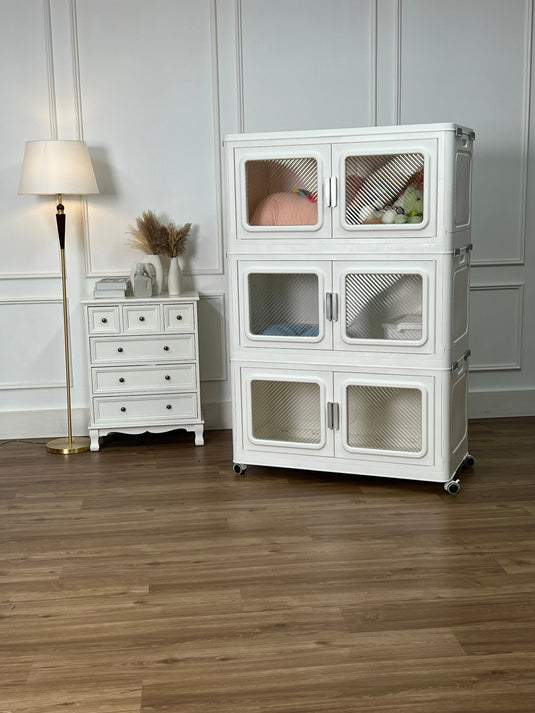
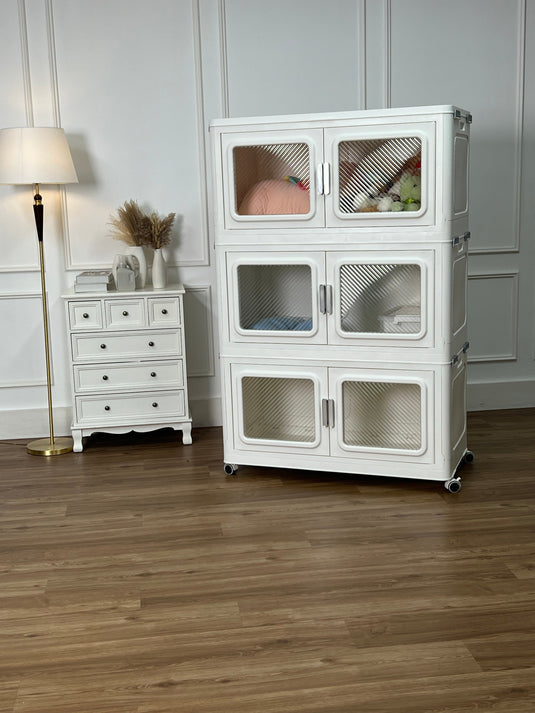
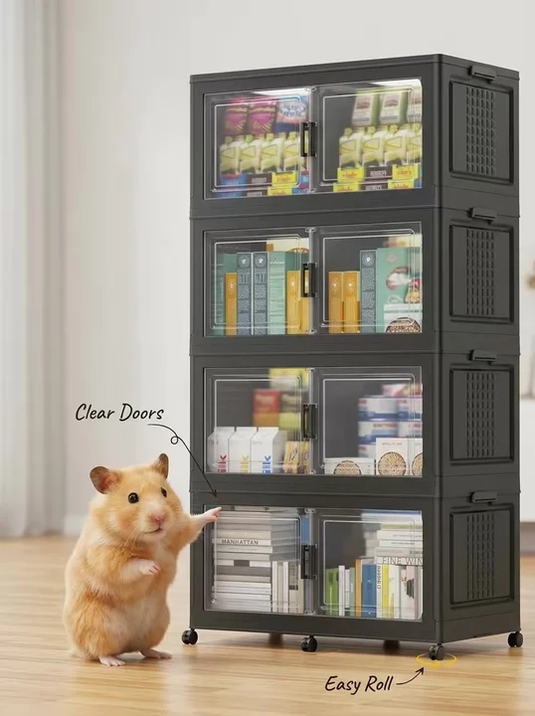
The front doors are clear (a glass-like PET panel, not actual glass), so you can see which zone is which before opening anything. The doors open from the front, so you can reach the right side of a tier without pulling the whole thing out or unstacking the levels above. Underneath, the cabinet rolls on wheels, so the heavy one moves where the mess is, not the other way around.
Where the V40 Actually Helps
If you're outfitting a kitchen that has run out of cabinet space, the V40 is the overflow bin that knows what it's overflowing. Cookware on one side of the divider, paper towels and food containers on the other, and you can finally see which side to open when you need a lid instead of a baking sheet. The big-tote kitchen mess has a structure, without needing five smaller bins to enforce it.
If you're a parent, the V40 handles the toy category that always grows faster than expected. Building toys on one side, soft toys and bulkier items on the other. The kids can't see through opaque plastic, but they can see through the V40's clear doors, which means they actually look for the right section instead of dumping the whole bin onto the floor every time. It doesn't create perfect organizing, but it cuts the chaos in half.
If you share a closet or laundry zone with another adult, the divider is the easiest way to stop the slow merger of two wardrobes. His side, her side, and the bulky category (workout gear, off-season stuff) keeps its own zone without pushing either person's everyday clothes out. The capacity is real, the split is real, and nobody has to ask whose stuff is on top.
How the Options Compare
A big fabric tote gives you volume but no structure — the bottom is just where things go to die. A rigid plastic bin without a divider is the same problem in a sturdier box. Stackable drawer units can sort by drawer, but the drawers are usually too shallow for the bigger items, and you end up needing more of them. The V40 combines the capacity of the big tote with the sorting logic of the drawer unit, using one divider in one bin to do the work of two — without doubling the footprint. Move the divider when categories shift, take it out entirely when you need one big space. The bin follows your life instead of forcing your life into fixed compartments.
Setting It Up in Real Life
Pick the two categories that share a space right now and refuse to share well — pots and paper goods, building toys and dress-up, his clothes and hers. Decide which one wants the bigger half of the tier. Slide the divider where it needs to go, load each side, and close the clear door. The categories are now visible from across the room. When one side fills up faster than the other, slide the divider, no new bin required. When the whole tier is the same category for a season (say, all holiday bakeware in November), pull the divider out and use the full 200 quarts. Roll the cabinet out to vacuum behind it, roll it back when you're done.
Ready to Split One Bin Into Two?
If your "big box" has become a pile you dig through every morning, the BROVIEW V40 200QT is the bin that knows which job it's doing. One tier, one divider, two categories, and a clear front door so you can see both. See full specs, the exact divider setup that ships with the configuration you're buying, and which tier count fits your space.
Q: How big is each tier?
About 200 quarts per tier — enough for the Costco paper towels, the roasting pan, the off-season clothes, or the bulkier end of any category in your home.
Q: Does the divider come with it?
The V40 is sold as a tier with a built-in divider slot. Check the exact configuration on the product page for the SKU you're considering, since the divider setup can vary.
Q: Can I take the divider out?
Yes. The divider is removable, so you can use the tier as one large 200-quart space whenever one category takes over.
Q: Can I reach the bottom of the tier when the divider is in?
Yes. The clear front doors open from the front, and the divider sits in the middle — you open the door, see both zones, and reach in normally on either side.
Q: Does it move?
Wheels underneath let the whole cabinet roll out for cleaning or rearranging — no lifting a loaded box across the floor.